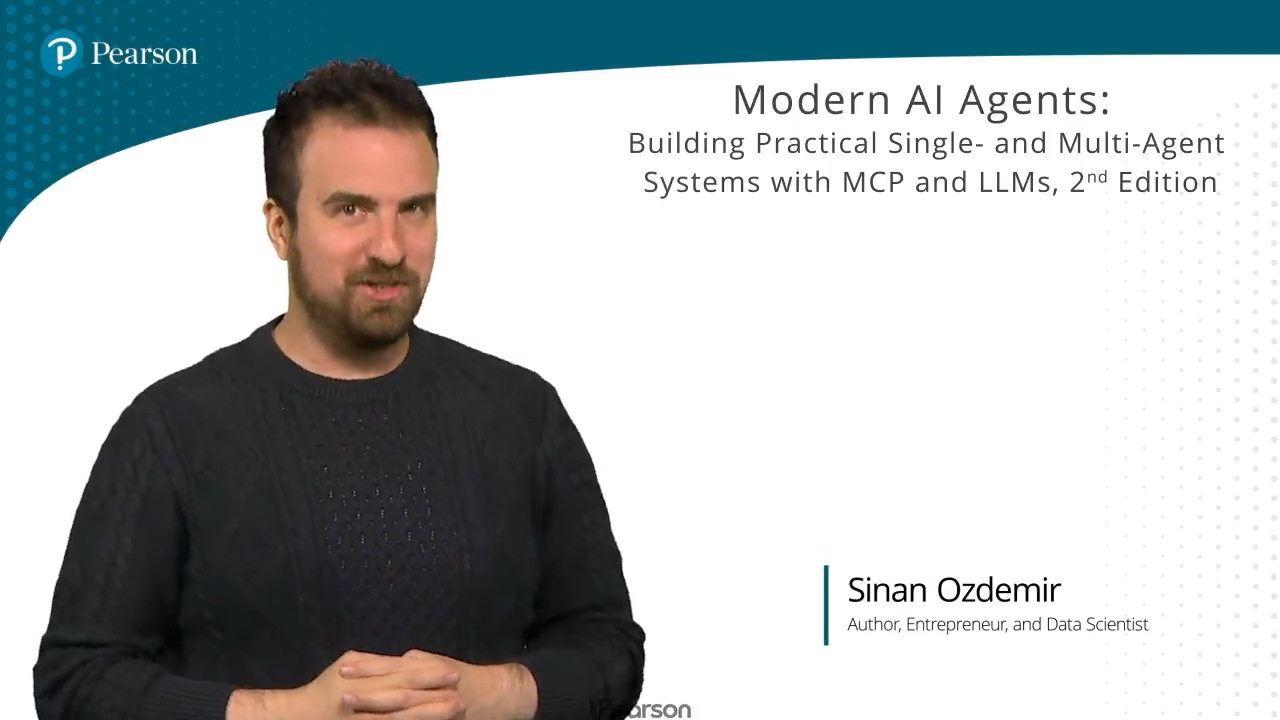
Modern AI Agents: Building Practical Single- and Multi-Agent Systems with MCP and LLMs (Video Course), 2nd Edition
- By Sinan Ozdemir
- Published Dec 18, 2025 by Addison-Wesley Professional.
Online Video
- Your Price: $319.99
- List Price: $399.99
- About this video
Video accessible from your Account page after purchase.
Register your product to gain access to bonus material or receive a coupon.
Description
- Copyright 2026
- Edition: 2nd
- Online Video
- ISBN-10: 0-13-588259-1
- ISBN-13: 978-0-13-588259-7
Get started with automated AI agents
Modern AI Agents introduces you to the concept of automated agents and helps you build a solid understanding of how to design, build, and optimize AI agents to tackle real-world challenges. This second edition expands significantly on production deployment, multi-agent systems, and cutting-edge techniques like MCP integration and reasoning LLMs.
Learn How To:
- Build and use AI agents with CrewAI and LangGraph
- Evaluate and compare leading AI agent frameworks
- Design multi-step workflows and multi-agent architectures
- Integrate existing and custom tools using MCP (Model Context Protocol)
- Use thought, action, observation, and response components
- Test and evaluate agents, their responses, backstories, definitions, and rules
- Add planning and reflection to agents to bolster performance
- Deploy agents in production with Docker
- Enhance agents with memory, code execution, and computer control capabilities
- Fine-tune agents for specialized tasks
Who Should Take This Course:
Developers, data scientists, and engineers who are interested in building intelligent, autonomous AI agents capable of solving complex problems and adapting to dynamic environments
Course Requirements:
- Python 3 proficiency with some experience working in interactive Python environments including Notebooks (Jupyter/Google Colab/Kaggle Kernels)
- Should be comfortable using the Pandas library and either Tensorflow or PyTorch
- Have an understanding of ML/deep learning fundamentals including train/test splits, loss/cost functions, and gradient descent
Lesson Descriptions:
Lesson 1: Introduction to AI Agents: Lesson 1 explores the components of a modern AI agent, their core components, and how they differ from the LLMs under the hood. You survey leading agent frameworks, take your first steps building agents with CrewAI, and design multi-step workflows with LangGraph.
Lesson 2: Under the Hood of AI Agents: Lesson 2 dives into the mechanics of AI agents, exploring how large language models power agent workflows. You gain insight into how tools, prompts, and agent contexts work together to create intelligent systems, and learn to create agents directly with LangGraph.
Lesson 3: Building an AI Agent Framework: In Lesson 3, its time to put theory into practice by designing and building your own fully functional AI agent framework. You build custom tools, construct viable prompts, and learn to handle user inputs dynamically to create adaptable end-to-end agentic systems.
Lesson 4: Testing and Evaluating Agents: Lesson 4 focuses on measuring agent performance, covering tool selection evaluation, response quality assessment, and strategies for evaluating agent backstories, task definitions, and rules to ensure reliable outcomes.
Lesson 5: Expanding on ReAct with Planning and Reflection: Lesson 5 enhances your agents with planning and reflection techniques, enabling them to reason through tasks with more care. You explore why agents fail, build plan-and-execute and reflection agents, leverage reasoning LLMs, and give agents the capability to write and execute code.
Lesson 6: Agents in Production: Lesson 6 tackles real-world deployment with multi-agent architectures, MCP integration to empower agents with external capabilities, and a complete multi-agent AI SDR implementation using Docker, MCP, and LangGraph. It shows how multiple specialized agents can collaborate on complex tasks and how MCP (Model Context Protocol) provides a standardized way to connect agents to external tools and data sources.
Lesson 7: Agent Case Studies: Lesson 7 presents practical case studies that push agent capabilities further: making agents smarter with memory, enabling agents to control computers, and fine-tuning agents for specialized performance. These hands-on examples illustrate how persistent memory transforms agent interactions, how agents can navigate and manipulate desktop environments, and how fine-tuning can optimize agent behavior for domain-specific tasks.
Lesson 8: Advanced Applications and Future Directions: Lesson 8 covers emerging trends including additional tools and APIs, and explores the future landscape of AI agents. It examines where the field is headed, from evolving best practices to ethical considerations around automating increasingly complex workflows.
Sample Content
Table of Contents
Lesson 1: Introduction to AI Agents
Lesson 2: Under the Hood of AI Agents
Lesson 3: Building an AI Agent Framework
Lesson 4: Testing and Evaluating Agents
Lesson 5: Expanding on ReAct with Planning and Reflection
Lesson 6: Agents in Production
Lesson 7: Agent Case Studies
Lesson 8: Advanced Applications and Future Directions
More Information
Other Things You Might Like
Exam AI-300 Operationalizing Machine Learning and Generative AI Solutions (Video)
- Online Video $399.99
